30 November: your YA 2026 tax return, and three other things due the same day.
The YA 2026 Corporate Income Tax Return is due on 30 November 2026. So are the EIS cash payout application, the CIT Rebate Cash Grant appeal and the last SkillsFuture Enterprise Credit claims. What to file, which form to use, and what to decide first.
By MTM Associate · · 6 min read
Every Singapore company has to file its YA 2026 Corporate Income Tax Return by 30 November 2026. That includes companies that made a loss, dormant companies that are still marked active, and companies that closed their first accounts in 2025.
This year, three other things share the date: the application for the EIS cash payout, the appeal window for the CIT Rebate Cash Grant, and the last day to claim the current SkillsFuture Enterprise Credit. Miss 30 November and some of these are gone for good.
Here is what to do, in the order that matters.
1. File the YA 2026 return
YA 2026 covers your financial year that ended in 2025. You file on myTax Portal, and the person filing needs Corppass authorisation as an “Approver” for Corporate Tax (Filing and Application). If a new director or staff member is filing this year, set this up now. Corppass access is a common last-minute hold-up.
Directors remain responsible for filing on time and accurately, even when a tax agent does the work (IRAS).
Which form?
| Form | Who it is for |
|---|---|
| Form C-S (Lite) | Qualifies for Form C-S, with revenue of S$200,000 or below. Six essential fields. |
| Form C-S | Singapore-incorporated, revenue of S$5 million or below, only income taxed at 17%, and not claiming carry-back relief, group relief, investment allowance or foreign tax credits |
| Form for Dormant Company | No business and no income in the year. Two declarations. |
| Form C | Everyone else. Financial statements and tax computation are filed with it. |
With Form C-S and Form C-S (Lite), you do not submit financial statements or a tax computation. You still have to prepare them, and produce them if IRAS asks.
Two common errors IRAS flags: claiming expenses that are not deductible, such as S-plated car costs, and, on Form C-S (Lite), an “Adjusted Profit/Loss before Capital Allowances” figure that does not match net profit before tax when there are no tax adjustments. IRAS’s free Basic Corporate Income Tax Calculator checks for both.
Dormant companies
Check the company’s status under “Update Corporate Profile” on myTax Portal before you file anything:
- No Business Done: no return is needed for YA 2026.
- Active: file using the Form for Dormant Company.
If the company will not trade for a while, you can apply for a waiver from filing future returns (IRAS). To qualify, the company must have filed all returns up to the date it stopped business, own no investments (or earn nothing from them), be deregistered for GST if it was registered, and have no plan to restart within two years. After you apply, you have 21 days to file any outstanding returns, or the application is rejected.
2. Don’t deduct the rebate yourself
YA 2026 has an enhanced CIT Rebate of 50% of tax payable. Companies that meet the local employee condition also received a S$2,000 cash grant. The rebate and grant together are capped at S$40,000 (IRAS).
IRAS applies the rebate automatically. The chargeable income in your return should not include it.
Cash grant missing? Appeal by 30 November. The grant was paid automatically by the second quarter of 2026 to active companies that made CPF contributions for at least one local employee (Singapore Citizen or PR, excluding shareholder-directors) in 2025. If your company met the condition and did not receive it, email IRAS through myTax Mail with the subject “Appeal for CIT Rebate Cash Grant”, with supporting documents, by 30 November 2026.
3. Decide: EIS deduction or cash
If you spent money on qualifying Enterprise Innovation Scheme (EIS) activities in FY2025, you have a choice. The activities are training, IP registration, IP acquisition and licensing, R&D done in Singapore, and innovation projects with polytechnics and other qualified partners. You can take a 400% tax deduction, or convert up to S$100,000 of the spend into a 20% cash payout: up to S$20,000, and not taxable (IRAS).
The timing catches people out. You can only apply for the cash payout after filing the return, and the application closes on 30 November 2026. File the return on the last day and you leave yourself no time to apply.
Conditions for cash:
- Active business operations in Singapore, with at least S$400 of qualifying spend.
- CPF contributions for at least three full-time local employees for at least six months of the basis period. Each must be a Singapore Citizen or PR, earning at least S$1,400 a month and working at least 35 hours a week.
- Sole proprietors, partners and shareholder-directors do not count towards the three.
Why YA 2026 tilts towards cash
The 50% rebate halves the tax a deduction saves you. It does nothing to the cash payout. So the question is what rate the deduction would save tax at.
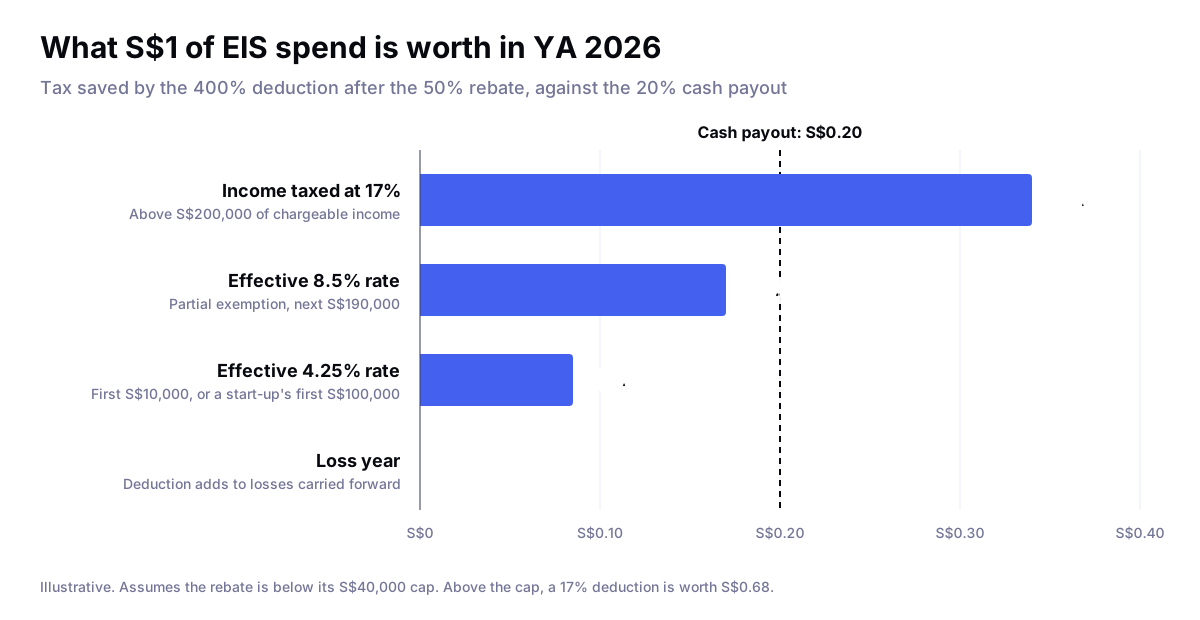
| Where the deduction lands | 400% deduction, after the 50% rebate | Cash payout |
|---|---|---|
| Income taxed at the full 17% | S$0.34 | S$0.20 |
| Effective 8.5% (partial exemption, next S$190,000) | S$0.17 | S$0.20 |
| Effective 4.25% (first S$10,000, or a start-up’s first S$100,000) | S$0.085 | S$0.20 |
| Loss year | S$0 now | S$0.20 |
In short:
- If the deduction comes off income in the 17% band, the deduction usually still wins.
- Below that, cash wins, as long as you meet the three-employee test.
- If your rebate has already hit the S$40,000 cap, cutting your tax no longer cuts your rebate. The deduction is then worth the full S$0.68.
- A deduction in a loss year is not wasted. It adds to losses carried forward. But for a young company, cash now is often worth more.
The choice is irrevocable, and the cash replaces the whole deduction on that spend, including the normal 100%.
Looking ahead: the new 400% deduction for AI spend starts from YA 2027 and has no cash option. We covered it in The new 400% AI tax deduction.
4. Use the SkillsFuture Enterprise Credit
The SkillsFuture Enterprise Credit (SFEC), a one-off credit of up to S$10,000 per eligible employer, expires on 30 November 2026 (Enterprise Singapore). Final claims for supported programmes must reach the relevant agencies by that date, for courses completed by then.
From 1 December 2026, support moves to the redesigned SFEC (Enhanced), run by the Skills and Workforce Development Agency (SWDA). Plan as though any unused balance on the current credit lapses.
After you file
- IRAS reviews the return and issues a Notice of Assessment (NOA).
- Pay within one month of the NOA, even if you object. GIRO is the preferred method.
- Object or ask for a revision within two months of the NOA.
- From 1 July 2027, IRAS plans to require all companies to use its Revise/Object to Assessment digital service, subject to the Finance (Income Taxes) Bill 2026.
What happens if you miss it
Treat 30 November as fixed. If the return is late, IRAS can (IRAS):
- Issue an estimated assessment. The tax is payable within one month, even if you object.
- Offer a composition of up to S$5,000 per offence, depending on past compliance. You still have to file.
- Issue a summons to the company, its directors, or both.
- Require directors to provide information. A director who fails to comply faces a fine of up to S$10,000, up to 12 months’ imprisonment, or both, per offence.
- For two or more years of non-filing, on conviction: a penalty of twice the tax assessed, plus a fine of up to S$5,000.
Your checklist for the next 19 days
- Check Corppass: does the person filing have the Approver role?
- Close the FY2025 accounts and prepare the tax computation, even if you file Form C-S (Lite).
- Pick the form using your revenue and the Form C-S conditions.
- Dormant? Check “Update Corporate Profile” first.
- Leave the rebate out of chargeable income.
- EIS spend? Work out deduction or cash, file the return early, then apply for cash before 30 November.
- Cash grant missing? Appeal by 30 November.
- Submit final SFEC claims.
- Set up GIRO for the tax bill.
Sources
- IRAS: Corporate Income Tax Filing Season 2026
- IRAS: Corporate Income Tax Rate, Rebates and Tax Exemption Schemes
- IRAS: Enterprise Innovation Scheme
- IRAS: Dormant companies
- IRAS: Late filing or non-filing of Corporate Income Tax Returns
- Enterprise Singapore: SkillsFuture Enterprise Credit FAQ
This article is general information as at 11 November 2026, not tax advice for your situation. Check the conditions against IRAS guidance, or speak to us, before you file or claim.