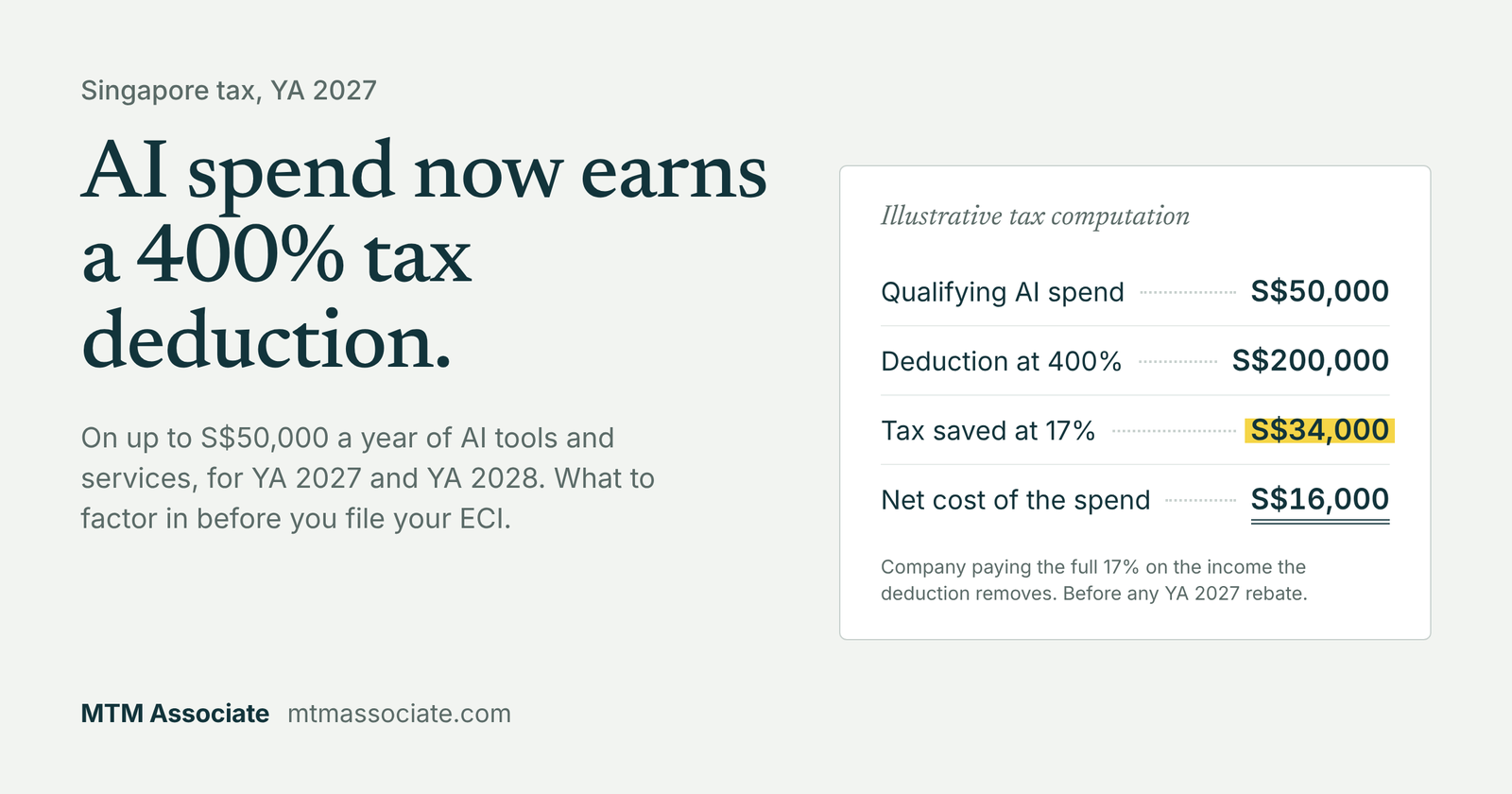
For the first time, money spent on AI can earn a 400% tax deduction, and YA 2027 is the first year it counts. If your company’s financial year ends in 2026, you will soon be filing Estimated Chargeable Income (ECI) for YA 2027. Now is the time to build the deduction into your numbers.
Budget 2026 added AI adoption as a new activity under the Enterprise Innovation Scheme (EIS). A few other incentives also change from YA 2027. Here is what to look out for before you file.
The new 400% deduction for AI spend
What: A 400% tax deduction on qualifying AI subscriptions, licences and AI services.
How much: The first S$50,000 of qualifying AI spend each year. This cap is separate from the other EIS caps.
When: YA 2027 and YA 2028 only. YA 2027 covers spend in your financial year ending in 2026.
Cash option: None. Unlike the other EIS activities, AI spend cannot be converted into a cash payout.
How to claim: In your company’s income tax return. Spend that is not normally deductible still gets the full 400%.
IRAS set out the details in the third edition of its EIS e-Tax guide, published 31 August 2026.
What counts
- Subscriptions and licences for AI systems, such as generative language models, machine-learning models and computer-vision tools.
- AI business services from a provider: online platforms, system development, consultancy, data and analytics, and training. They must relate to developing, deploying, operating or maintaining an AI system.
What does not
- Physical infrastructure and hardware, such as servers and devices.
- The part of the cost paid by a government grant. If you bought an AI tool under a productivity grant, only your unfunded share counts.
- Spend already claimed under another deduction or allowance.
Watch the bundled software
Many tools now come with AI built in. Mixed-use costs must be split on a reasonable basis, and you keep the working in case IRAS asks.
Example: The e-Tax guide uses a S$12,000 AI-enabled subscription where the standard package costs S$8,000. Only the S$4,000 AI premium qualifies. Ask your vendors to show AI add-ons as separate invoice lines.
What it is worth
Two illustrative companies, both on the partial tax exemption, before any YA 2027 rebate:
| Company A | Company B | |
|---|---|---|
| Chargeable income before deducting the AI spend | S$500,000 | S$150,000 |
| Qualifying AI spend in FY2026 | S$50,000 | S$20,000 |
| Deduction at 400% | S$200,000 | S$80,000 |
| Tax saved | S$34,000 | S$6,800 |
| Net cost of the AI spend after tax | S$16,000 | S$13,200 |
| Extra saving vs a normal 100% deduction | S$25,500 | S$5,100 |
Company A’s deduction comes off income taxed at the full 17%. Company B’s comes off income taxed at an effective 8.5%, so the benefit is half as rich.
Timing
For a 31 December year-end, FY2026 spend runs to 31 December 2026, about ten weeks from now. The guide does not address multi-year prepayments, so do not assume a three-year licence paid upfront all counts in YA 2027. And buy tools you will actually use: the deduction reduces the cost, it does not remove it.
The rest of the EIS still applies
The original five EIS activities run until YA 2028. YA 2027 spend on them still earns a 400% deduction, or a 20% cash payout instead (IRAS).
| Activity | 400% on the first |
|---|---|
| Training eligible for SWDA (formerly SkillsFuture Singapore) funding and aligned with the Skills Framework | S$400,000 a year |
| Registration of IP | S$400,000 a year |
| Acquisition and licensing of IP rights (revenue below S$500 million) | S$400,000 a year |
| Qualifying R&D done in Singapore | S$400,000 a year |
| Innovation projects with polytechnics, ITE or other qualified partners | S$50,000 a year |
For YA 2027 and YA 2028, the qualified partners also include the Sectoral AI Centre of Excellence for Manufacturing. For training, the qualifying costs are course, assessment and certification fees paid to SWDA-registered providers, net of any grants.
Deduction or cash?
You can convert up to S$100,000 of spend on these five activities into a tax-free 20% cash payout, capped at S$20,000 a year. The choice is irrevocable, and it replaces the whole deduction on that spend, including the normal 100%.
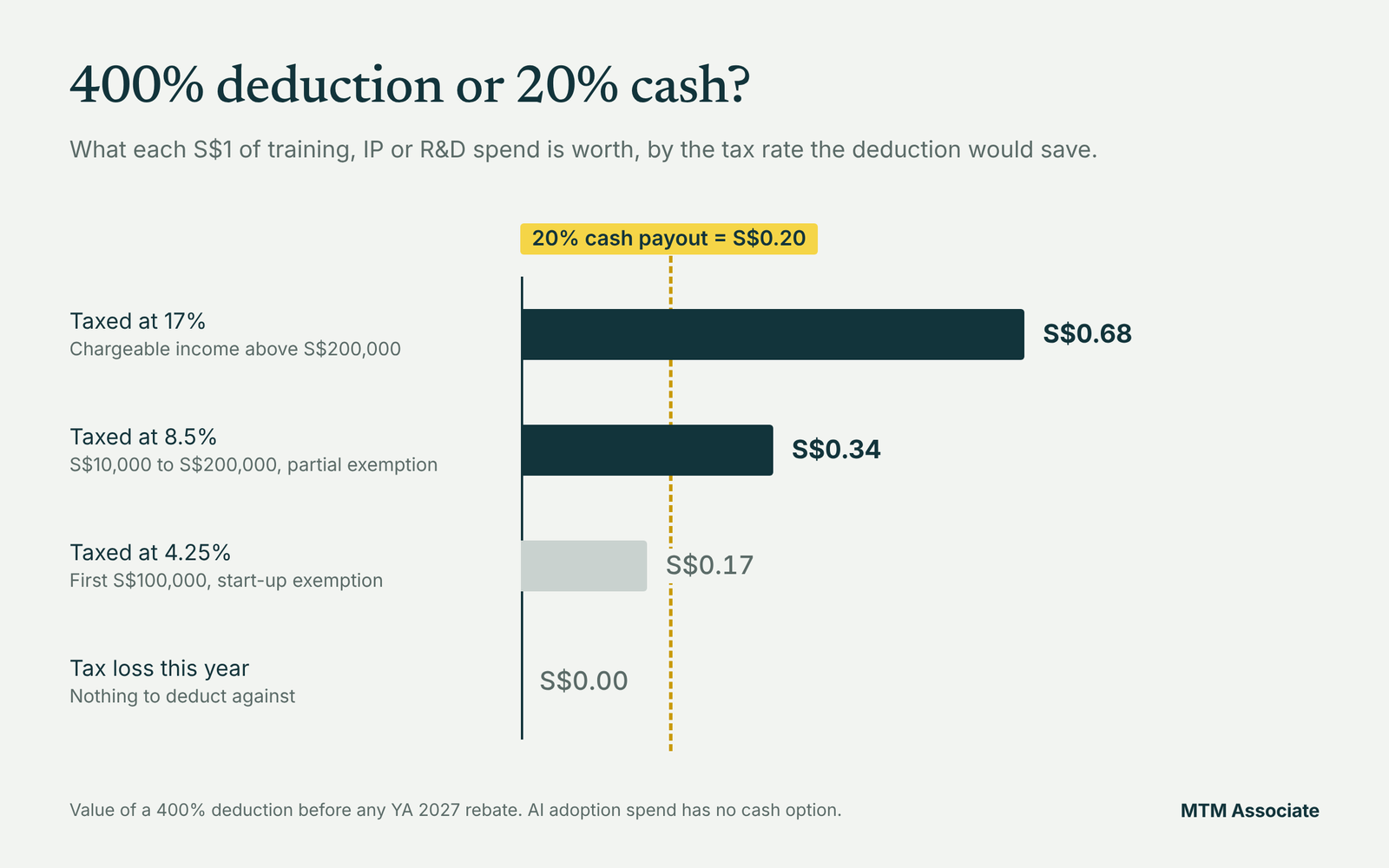
Which is better depends on the tax rate the deduction would save. At 17% or 8.5%, the deduction wins. In a start-up’s first S$100,000 of income, or in a loss year, the cash wins. These figures are before any rebate. A rebate cuts the value of a deduction but not the cash, which is why cash often won in YA 2026.
Conditions for cash: At least three full-time local employees on CPF for at least six months of the year. You apply on myTax Portal after filing your return and before the filing due date, which is 30 November for companies. Your ECI should reflect the route you expect to take.
Going overseas: a bigger 200% deduction
From YA 2027, you can claim the 200% Double Tax Deduction for Internationalisation (DTDi) on up to S$400,000 of qualifying spend a year without prior approval, up from S$150,000 (Budget 2026, Annex B-1).
The list of activities that need no approval also widens:
- All eligible costs of overseas market development trips and overseas investment study trips
- Investment feasibility and due diligence studies
- Master licensing and franchising
- Market surveys and feasibility studies
- Overseas business development
- Production of corporate brochures for overseas distribution
These join existing no-approval activities such as overseas trade fairs and overseas advertising. Spend above S$400,000, overseas trade offices and e-commerce campaigns still need approval from Enterprise Singapore or the Singapore Tourism Board.
Example: S$40,000 of qualifying overseas spend gives an extra S$40,000 deduction, worth S$6,800 of tax at 17%.
Other things to factor into your YA 2027 estimate
- No rebate, yet. YA 2026 had an enhanced 50% corporate tax rebate with a S$2,000 cash grant, capped at S$40,000 (IRAS). As at 21 October 2026, no rebate has been announced for YA 2027. Estimate without one.
- Exemptions unchanged. Under the partial exemption, 75% of the first S$10,000 and 50% of the next S$190,000 of chargeable income are exempt. Qualifying start-ups in their first three YAs get 75% off the first S$100,000 and 50% off the next S$100,000.
- Carbon credits and RECs. Qualifying carbon credits and Renewable Energy Certificates get a 100% deduction from YA 2026, including those bought for voluntary sustainability goals. The deduction falls in the year the credits are surrendered or retired.
- Giving back. The 250% deduction for donations to IPCs and the 250% Corporate Volunteer Scheme deduction both run to 31 December 2029.
- Government payouts received in FY2026. Check the tax treatment of each one before finalising income. The CIT Rebate Cash Grant and the EIS cash payout are not taxable.
ECI deadlines and a checklist
ECI is due within three months of your financial year end (IRAS). You do not need to file if annual revenue is S$5 million or less and ECI is nil.
| Financial year end | ECI due |
|---|---|
| 30 September 2026 | 31 December 2026 |
| 31 October 2026 | 31 January 2027 |
| 31 December 2026 | 31 March 2027 |
Filing early pays off if you pay by GIRO: up to 10 monthly instalments if you file by the 26th of the first month after year-end, 8 by the second month and 6 by the third.
Before you file:
- List every AI subscription, licence and AI service paid in FY2026. Split AI add-ons from base software and net off any grants.
- Take out hardware and devices. They do not qualify for the AI deduction.
- Tag training invoices from SWDA-registered providers, net of course funding.
- Gather overseas trip, trade fair and market study invoices for the DTDi.
- Decide deduction or cash for the original five EIS activities, and check the three-employee test if you lean towards cash.
- Estimate without a YA 2027 rebate, and update if Budget 2027 announces one.
- File early on GIRO to spread the tax over more instalments.
Sources
- IRAS e-Tax Guide: Enterprise Innovation Scheme, third edition (31 August 2026)
- IRAS: Enterprise Innovation Scheme
- Ministry of Finance: Budget 2026, Annex B-1
- IRAS: Corporate Income Tax Rate, Rebates and Tax Exemption Schemes
- IRAS: Estimated Chargeable Income (ECI) Filing
This article is general information as at 21 October 2026, not tax advice for your situation. Incentive conditions are detailed, so check them against IRAS guidance or speak to a tax adviser before you claim.