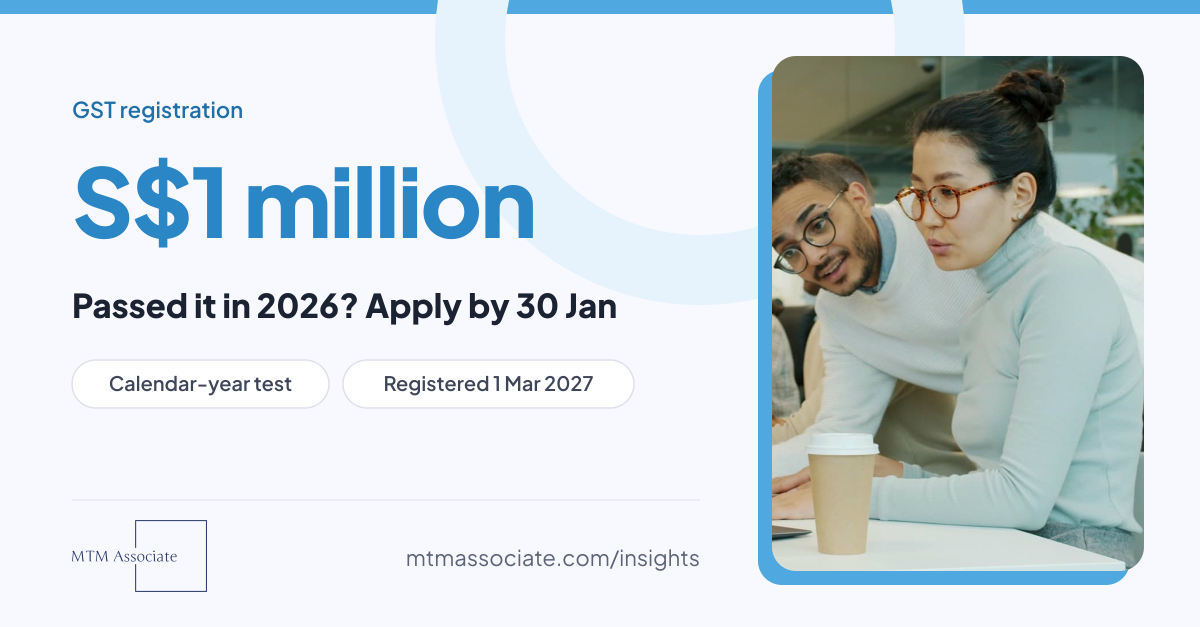
Did your business pass S$1 million in 2026? Check GST registration before 30 January.
If your taxable turnover for calendar year 2026 is more than S$1 million, you must apply for GST registration between 1 and 30 January 2027. How the test works, what counts, the exceptions, and what happens if you register late.
By MTM Associate · · 5 min read
Crossing S$1 million in revenue is a good year. It can also mean you have to register for GST, and the check happens on a fixed date: 31 December.
If your taxable turnover for calendar year 2026 is more than S$1 million, IRAS expects you to apply for GST registration between 1 and 30 January 2027. You would then be registered from 1 March 2027 (IRAS).
Here is how the test works, what counts towards the S$1 million, and what to do in the six weeks before year end.
Two ways you become liable
IRAS uses two tests. You must register if either one applies (IRAS).
The year-end look-back (retrospective view)
At the end of each calendar year, look at your taxable turnover from 1 January to 31 December. If it is more than S$1 million, apply for registration between 1 and 30 January of the following year. Registration then takes effect on 1 March.
| Taxable turnover in | Apply between | Registered from |
|---|---|---|
| 1 Jan to 31 Dec 2026 | 1 to 30 Jan 2027 | 1 Mar 2027 |
This is the calendar year, whatever your company’s financial year end is.
If you passed S$1 million partway through the year and you don’t reasonably expect more than S$1 million in the next 12 months, IRAS says you don’t need to register immediately. You can wait for the year-end check, or register voluntarily if you meet the conditions.
The forward look (prospective view)
At any point, if you can reasonably expect your taxable turnover to be more than S$1 million in the next 12 months, you must apply within 30 days of that date. IRAS calls it the date of forecast.
For a liability that arises on or after 1 July 2025, you are registered 2 months from the date of forecast. The 30-day deadline to apply hasn’t changed.
“Reasonably expect” means you have evidence. IRAS gives examples:
- a signed contract or agreement worth more than S$1 million
- an accepted quotation or confirmed purchase order
- invoices to customers with a fixed monthly fee
- income statements showing the past 12 months were already close to S$1 million, with turnover rising
A forecast based only on market assessments, business plans or sales targets doesn’t trigger registration. So if you closed a big contract this quarter, check this test now rather than waiting for December.
What counts towards the S$1 million
The test uses taxable turnover, which is narrower than total revenue (IRAS).
| Included | Excluded |
|---|---|
| Standard-rated supplies, such as local sales of goods and services | Exempt supplies, such as financial services |
| Zero-rated supplies, such as exports of goods and international services | Out-of-scope supplies |
| Sales of capital assets, such as equipment or an office |
Two points catch founders out.
Exports and overseas clients count. If most of your revenue is from overseas customers, that turnover can be zero-rated. Zero-rated sales are still taxable supplies, so they count towards the threshold.
The test is per legal entity, with a twist for sole proprietors. A company looks at its own turnover. A sole proprietor adds up all their sole proprietorships and income from their trade or profession, such as freelance work. Partnerships with the same partners are combined.
The exceptions
You may not have to register if either of these applies (IRAS):
- Your taxable turnover is wholly or mainly zero-rated, and you apply for exemption from registration.
- You pass the year-end test but your next 12 months will be under S$1 million because of specific circumstances. IRAS lists examples such as a major sales contract ending, large-scale downsizing, losing a licence or distribution rights, or ceasing business. You need documents and a detailed projection to support this, and you have to check again at the end of the next calendar year.
A slow quarter or a cautious budget isn’t one of the specified circumstances.
If you register late
IRAS is direct about this (IRAS):
- Your registration is backdated to the date you should have been registered.
- You have to account for and pay GST on past sales from that date, even if you didn’t collect GST from your customers.
- You may face a fine of up to S$10,000 and a penalty of 10% of the GST due. Prosecution may apply.
If you voluntarily disclose that you’re late when you apply, IRAS says it will generally waive the late notification fine and penalties. The backdated GST is still payable, and IRAS may allow instalments if you have difficulty paying.
At a GST rate of 9% (IRAS), GST on a few months of sales you never charged for can be a real cash hit. That’s the main reason to do the check on time.
What to do before 31 December
- Run the numbers by calendar year. Pull your sales from 1 January 2026 to date, take out exempt and out-of-scope income and capital asset sales, and project to 31 December.
- Check the forward test too. Signed contracts, accepted quotes and recurring monthly fees all count as evidence. If they add up to more than S$1 million over the next 12 months, the 30-day clock may already be running.
- Use the IRAS GST Registration Calculator linked from the IRAS page to confirm.
- Prepare your systems and pricing. From your registration date you charge 9% GST on standard-rated sales and file GST returns. Contracts and price lists may need to say whether prices include GST.
- Know the InvoiceNow position. Businesses that register voluntarily from 1 April 2026 already have to send invoice data to IRAS through InvoiceNow, and new compulsory registrants follow from 1 April 2028 (IRAS). Our InvoiceNow guide has the dates.
Thinking of registering voluntarily?
If you’re close to the threshold, registering voluntarily means you don’t have to watch turnover constantly. But a voluntary registration must stay in place for 2 years, so IRAS suggests weighing the costs and benefits over that period (IRAS). If you apply voluntarily, you are registered within 2 weeks of the approval letter, and the date isn’t backdated for claiming input tax (IRAS).
Sources
- IRAS: Do I need to register for GST
- IRAS: Applying for GST registration
- IRAS: Factors to consider before registering voluntarily for GST
- IRAS: Current GST rates
- IRAS: GST InvoiceNow Requirement
This article is general information as at 19 November 2026, not tax advice for your situation. Check the conditions against IRAS or ACRA guidance, or speak to us, before you act.